Price food by calculating your cost per serving, then using your target food cost percentage or gross profit margin to set menu prices that cover overhead, stay competitive, and protect your profit.
Preparing delicious foods and beverages that sell is your ultimate goal, but if your revenue doesn’t justify your expenses, you won’t be in business for long. Learning how to price food items means understanding how to balance your direct and overhead costs with a strong strategy to maximize profit across your menu.
Pricing food takes some basic math, but it’s not rocket science. Our guide walks you through it all, from the calculations you need to make up front to the most common strategies food businesses use to ensure a profit.
Reality Check: What to Consider Before Pricing Your Food
Before you dive into crunching numbers and strategizing, consider the following factors (they’ll play a huge role in how you price your menu items):
- Food costs: You need to know the total amount you spend on ingredients for each item to calculate your food cost percentage later on.
- Labor costs: Time is money, and items that take more time (or skill) to make lead to higher labor expenses.
- Overhead costs: Your overhead accounts for fixed costs like rent, utilities, and insurance, as well as variable expenses like fuel (if you’re running a mobile food business).
- Customer demographics: Your prices should match your target customer. A food truck that primarily serves a corporate lunch crowd will have a different pricing strategy than an upscale restaurant.
- Competition: Having a solid understanding of what your competitors charge helps you anticipate what your customers expect to pay.
- Seasonality: This mainly affects the cost of your ingredients, as buying things out of season or shipping specialty ingredients from afar can drive up your costs.
- Brand: If you market your food business as a fast-casual option, your prices should reflect that.
Pro Tip: One overhead cost some business owners think they can skip is insurance. While it might feel like just another expense on an already lengthy list, a single claim or lawsuit can cost way more than a premium. Finding the right insurance and factoring this cost into your overhead helps make sure your menu prices actually support a sustainable business.
Learn more about food business insurance from Food Liability Insurance Program (FLIP).
How to Price Food Items: 2 Key Methods
There are two main approaches to pricing food: calculating prices based on food cost percentage or your target gross profit margin. Both are legit, tried-and-true starting points for determining what each menu item should cost.
Start with these menu pricing formulas before moving on to other strategies to get a solid understanding of what prices will actually earn you a profit and protect your bottom line.
Pricing Food Using Food Cost Percentage
Your food cost percentage refers to how much of your business’ revenue is spent on ingredients. Like your overhead costs, it can also be used to determine the best prices for your menu items.
To calculate your ideal food cost percentage, divide your total food costs by your total food sales:

This number can range between 25% for fast food or fast-casual businesses, all the way to 40% for full-service restaurants. In general, 28%-35% is considered the normal food cost percentage range. This means that 28%-25% of revenue goes towards purchasing new ingredients and supplies every week.
As an example of how this formula functions, let’s say your total food costs are $3,000 and your total food sales are $10,000. If we plug those numbers into the equation, it looks like this:
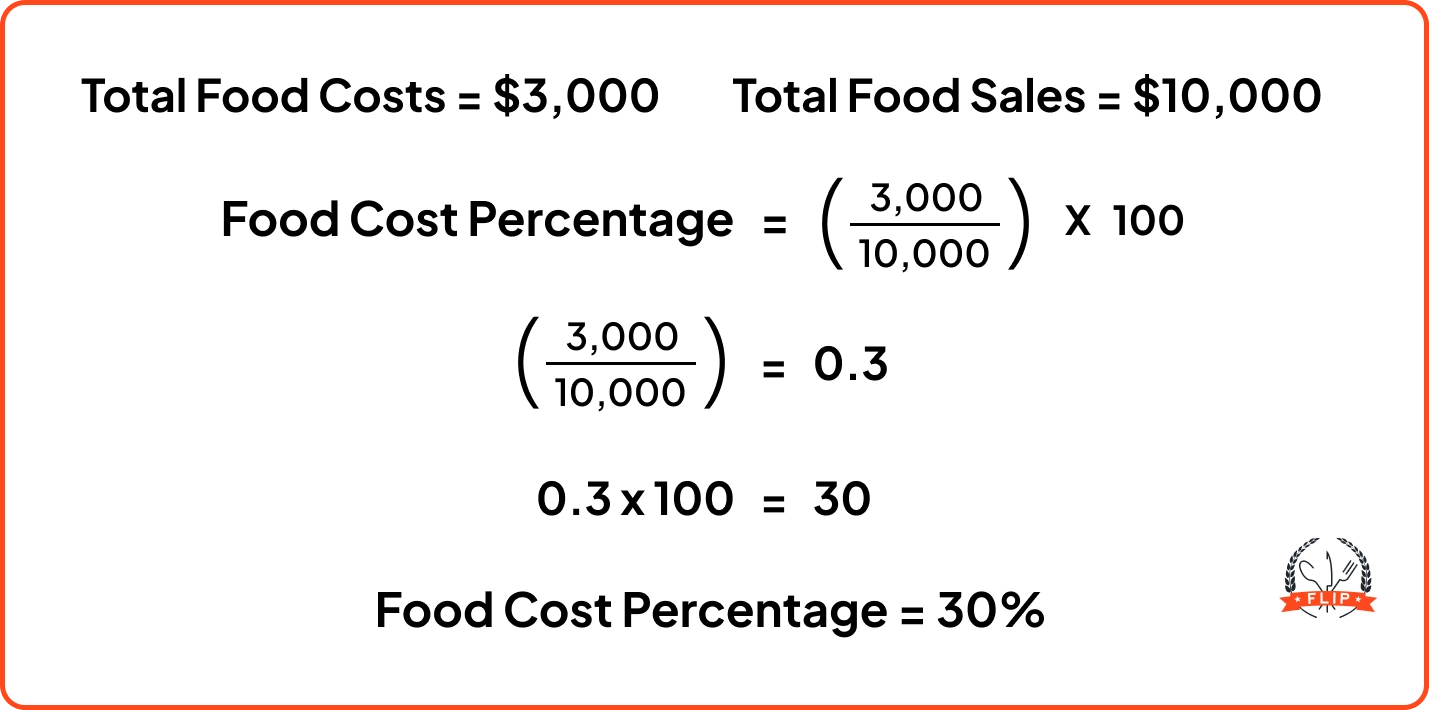
In this case, your ideal food cost percentage is 30%.
To determine your optimal menu price, divide your cost per serving by your ideal food cost percentage:

Let’s say the total food cost per serving is $3. First, convert your ideal food cost percentage into a decimal:

Now, use the optimal menu price formula:

Based on these calculations, the optimal menu price for this item would be $10.
Pro Tip: If you find that your food costs are too high to be sustainable, try using these methods to bring them down:
- Purchasing less expensive ingredients
- Decreasing food waste
- Reducing portion sizes
- Increasing menu prices

Pricing Food Using Target Gross Profit Margin
Your gross profit margin is the total amount of money your business makes after all direct expenses (e.g., food costs, labor) have been paid. Your target profit margin is what you want this number to be, even if you aren’t currently hitting that goal.
To calculate your gross profit margin on a specific menu item, subtract the item’s food cost from its menu price and then divide it by the menu price.

Picture this: it costs $9 to prepare a menu item, but you sell it for $30. Plugging those values into our formula, the calculation would look like this:
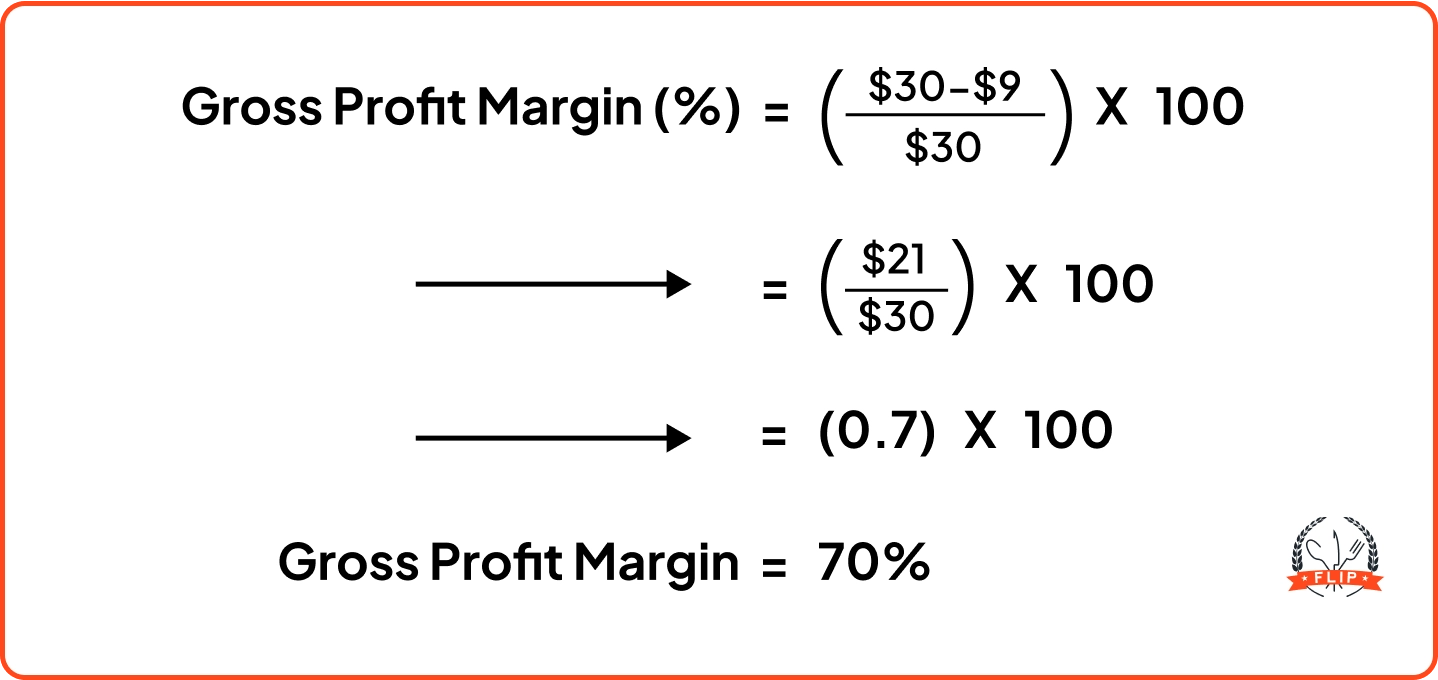
Your gross profit margin would be 70% for this specific menu item. This is typical for most food businesses, with most falling between 60%-75%.
Once you know your gross profit margin, use it to determine how to price a menu item by dividing the cost per serving by one minus the gross margin.

If your ideal gross profit margin is 60%, or 0.6, and your cost per serving is $3.50, your calculation would look like this, using the formula above:
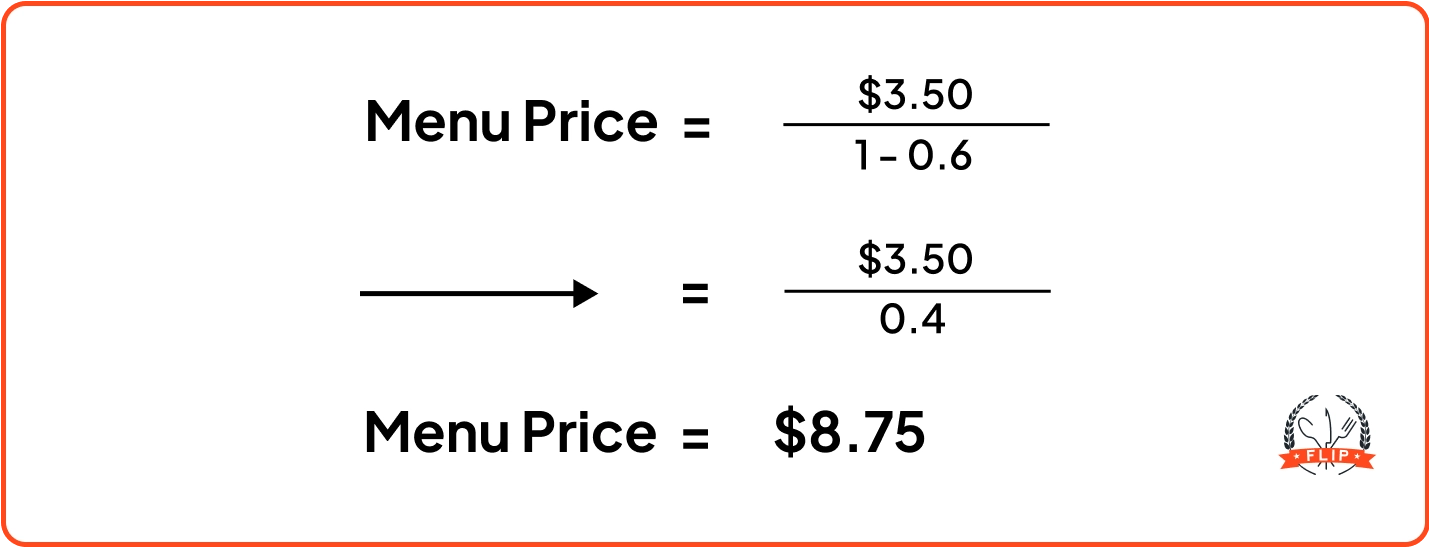
In this example, the menu item should cost the customer $8.75 to maintain a 60% target profit margin.
Pro Tip: Worried about negatively impacting sales of a menu item if you raise the price to meet your target profit margin? While it’s ideal for every item on your menu to be profitable, many food businesses make up for a slim margin on one item with a larger one on another.
For example, it’s normal to have a steep markup on beverages to balance out less profit on other non-beverage items. You may hear this referred to as menu engineering.
Popular Food & Beverage Pricing Strategies
The formulas covered above are key to understanding what you need to break even and what prices you should aim for to achieve your target gross profit margin. It doesn’t end there, though. There’s a strategic side to setting prices, and it’s not a step you want to skip.
Below are some of the most popular pricing strategies food and beverage businesses use to maximize profits and ensure long-lasting success.
Cost-Plus Pricing
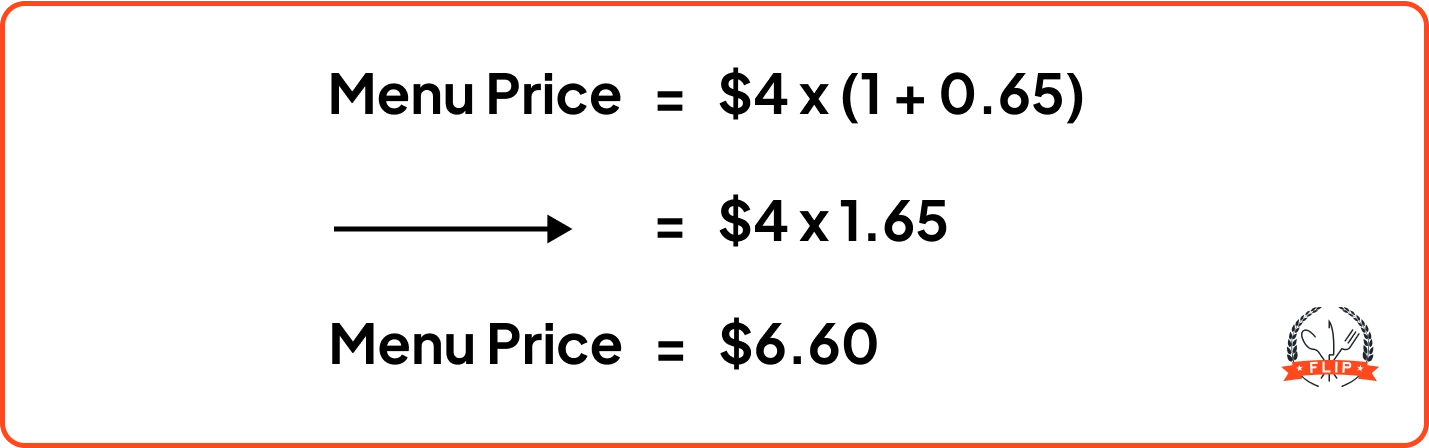
Cost-plus pricing is often considered the most basic food pricing strategy because it works for nearly any business. It follows a very simple formula:

If the total cost to produce a dish is $4, and your target profit margin is 65%, your calculation would look like this:
Best for: New businesses and business owners, or those with simple menus
Risk: It doesn’t account for what customers are willing to pay; the menu price you get after using this formula may be too high or too low, depending on how customers view the value of each item
Market-Based Pricing
This strategy involves pricing your menu items based on what competitors charge for similar items. Start by researching similar businesses in your area and adjust your prices slightly up or down, depending on what you see and how you want to position yourself in the market.
Best for: Crowded markets with fierce competition
Risk: You may accidentally underprice your items because your competitors are also underpricing theirs, cutting into your margins
Value-Based Pricing
In some cases, customers may be willing to pay more than just what you need to stay profitable. This can happen for a number of reasons, including that you:
- Use premium ingredients
- Cater to a specific dietary niche (e.g., gluten-free or plant-based)
- Have experience or special skills that set you apart from the competition
- Market your business as a premium, exclusive, or luxury option
Best for: Businesses with a unique offering
Risk: If your perceived value of your menu items doesn’t match your customers’ perceived value of them, your prices will appear too high, and sales can take a hit until you make adjustments
Competitive/Penetration Pricing
Competitive pricing — also known as penetration pricing — is similar to market-based pricing because it places importance on what competitors are charging. Where it differs is that competitive pricing always aims to undercut those prices with the goal of attracting customers quickly.
Best for: New businesses, especially during an initial launch period
Risk: It can be harder to raise your prices later on, especially if price was the main reason people chose your business over your competitors
Psychological Pricing
Psychological pricing uses tactics that have been shown to influence buying behavior, such as:
- Charm pricing: Listing products as $9.99 instead of $10, because people perceive prices ending in “9” to be significantly less than those ending in a rounded number (even if it’s only one cent more)
- Currency symbol effect: Removing dollar signs from your menu to encourage people to spend more because they aren’t associating the numbers with payment and loss of money
- Premium/prestige pricing: Setting higher prices on your premium-quality menu items to signal to customers that your version is better than what your competitors offer
Best for: All menus; there is at least one psychological pricing technique that works for every food and beverage business
Risk: If you use this strategy without a solid pricing foundation (aka pricing your items using food cost percentage or gross profit margin), you risk undermining your profits and losing money
Bundle Pricing
Technically a form of psychological pricing, bundle pricing groups various menu items together at a perceived discount to get customers to spend more than they would if they had to buy each item individually.
The best examples of this are combo meals, like a burger, a side of fries, and a drink, or catering packages that include an appetizer, main course, and dessert.
Best for: Increasing your average ticket size or order value
Risk: Discounting your bundles too heavily or pricing them without fully understanding your costs can result in less (or even lost) revenue
Dynamic Pricing
Incorporating a dynamic pricing strategy means adjusting your prices based on factors like:
- Demand (e.g., surge pricing)
- Seasonality
- Conditions (e.g., event pricing)
Best for: Experienced food business operators or well-established businesses
Risk: May result in customer frustration or confusion; also more difficult to manage than other pricing strategies because it requires constant, careful monitoring of demand, inventory, and costs
Choosing the Right Pricing Strategy for Your Business Type
Not every strategy will work for every business, and that’s okay. The key is that successful businesses typically use a combination of strategies to maximize profits without frustrating customers.
Below are a few recommended pricing strategies for various food and beverage businesses, along with key considerations that determine which strategies work best for each. Keep in mind, these are not hard-and-fast rules! You know your business better than anyone, so adopt different strategies as you see fit.
Swipe →
| Business Type | Considerations | Recommended Pricing Strategies |
|---|---|---|
|
Bakers |
|
|
|
Bartenders |
|
|
|
Caterers |
|
|
|
Cottage Food Makers |
|
|
|
Farmers Market Vendors |
|
|
|
Food Manufacturers |
|
|
|
Food Trucks/Trailers |
|
|
|
Restaurants |
|
|
Common Food Pricing Mistakes (& How to Avoid Them)
Pricing food often involves a little trial and error. You may set prices too low and need to raise them, or set them too high and find it hard to attract customers. It’s a delicate balancing act!
However, there are some common mistakes you can avoid right off the bat to save yourself an unnecessary headache.
Not Accounting for Time & Labor
Some food business owners make the mistake of pricing their menu items solely based on the cost of their ingredients. However, the time and labor it takes to make each item cost money, too, and should factor into the final price.
Only accounting for the cost of ingredients puts you at risk of undercharging your customers, leading to razor-thin margins. Or, in the worst-case scenario, losing money with each sale.
Keeping Prices the Same While Costs Increase
Every business has to adjust prices eventually, whether due to supplier changes or inflation. 80% of food business owners said rising prices negatively impacted their profitability last year.
Of course, this is never easy, as 51% of customers say increasing menu prices is their biggest frustration when eating out. However, it’s unavoidable in order to maintain a profitable business.
To make this difficult change a little easier, emphasize the value of your menu items in your marketing efforts. Remind customers what they’re paying for when they buy from you.
Copying Competitors Without Doing the Math
It can be extremely tempting — especially when you’re just starting out — to copy your competitors’ pricing because you know people are already willing to pay that much for a similar product.
The danger here is that you don’t know what your competitors’ costs are, or what their target gross profit margin is. They may have a much lower food cost percentage than you, so they can charge less than you need to and still make a solid profit.
While market-based pricing is a valid strategy, it can’t be the only one you rely on. Do your math up front and use your competitors’ prices as a guidepost, not a rulebook.
Protect Your Profits With Food Liability Insurance
Pricing your menu in smart, strategic ways is key to making a profit. The best way to protect those earnings? With liability insurance.
No matter what kind of food or beverage business you run, there is always risk involved. A customer might get sick after eating something you served them, or you might accidentally damage a space you rent, like a commercial kitchen.
These accidents can turn into expensive lawsuits. Without insurance, those expenses could hurt your bottom line.
That’s where Food Liability Insurance Program (FLIP) comes in. We offer affordable, easy-to-purchase policies designed specifically for food and beverage businesses. Most of our policies start at $25.92 a month and can be purchased entirely online.
Don’t wait until it’s too late! Get insured today and protect your earnings from the cost of an accident.
Do you run a brick-and-mortar food business, like a restaurant or cafe? FLIP can cover you, too! Learn more about our restaurant coverage and how it shields your business from expensive claims.

FAQs About How to Price Food Items
How Can I Test and Adjust My Menu Prices Without Losing Customers?
- Make small price increases rather than big jumps: Customers are less likely to decide not to order from you if their favorite item increases by 20 cents versus $1.00.
- Closely monitor your sales and margins: If you implement a price change and notice sales start to dip, it may not be worth it if you’re making less money with wider margins.
- Try seasonal adjustments: Certain ingredients may cost more if they aren’t in season, so include a note on your menu that explains why specific items experience a price fluctuation throughout the year.
- Be transparent: While nobody likes price increases, customers are way more likely to stick around if you give them a heads up about these changes via your socials, website, or signage. Explain the reason behind the increase and thank them for their continued support.
What Are Some Common Gross Profit Margin Ranges for Different Food and Beverage Businesses?
Below are some typical gross profit margin ranges for various food and beverage businesses.
| Business Type | Typical Gross Profit Margin Range |
|---|---|
|
Bar |
70%-80% |
|
Catering |
65%-75% |
|
Cottage Food |
60%-75% |
|
Farmers Market Vendor |
40%-60% |
|
Food Truck |
55%-65% |
|
Full-Service Restaurant |
60%-70% |
|
Quick-Service Restaurant |
65%-75% |
What Are the 5 Cs of Pricing?
The 5 Cs of pricing is a popular framework used by a wide variety of businesses — not just in the food and beverage space — to set prices strategically. They are:
- Costs: What does it cost you to produce your product? This includes ingredients, labor, packaging, and overhead expenses. The total represents the absolute minimum you need to charge for your product to break even.
- Customers: What are your customers willing to pay for your product? Consider the perceived value of your product, your customers’ price sensitivity, and your target audience (are they more interested in staying within a budget or getting a premium culinary experience?).
- Competition: What are your competitors charging for the same/similar products? This also helps you determine what your customers expect to pay versus what might give them sticker shock.
- Company: What are your main goals for your business? Maybe you want to maximize profit, or to portray yourself as the premium choice in your local market. Either way, your pricing strategy should match your ambitions.
- Context: What are the external factors beyond your control currently affecting your menu prices? This includes inflation, demand, supply chain disruptions, and government regulations.
What’s Considered a Good Food Cost Percentage?
A good food cost percentage for one business may not be the same for another, but they generally fall between 28% and 35%. For example, a catering business may have a higher ideal food cost percentage to account for labor expenses and the cost of fuel. On the other hand, businesses with lower overheads, like home-based bakers, tend to have a lower food cost percentage.

Alex Hastings
Seattle-based copywriter and (WA) licensed insurance agent Alex Hastings leverages her experience as a lover of fast-casual food, baked goods, and iced oat milk lattes. She holds a B.A. in Creative Writing from Western Washington University. Before working at Veracity, she was a retail copywriter at Zulily and an English language teacher in South Korea. Alex is fully trained on FLIP insurance coverages and writes content that connects food and beverage business owners with the policies they need.
Seattle-based copywriter and (WA) licensed insurance agent Alex Hastings leverages her experience as a lover of fast-casual food, baked goods, and iced oat milk lattes. She holds a B.A. in Creative Writing from Western Washington University. Before working at Veracity, she was a retail copywriter at Zulily and an English language teacher in South Korea. Alex is fully trained on FLIP insurance coverages and writes content that connects food and beverage business owners with the policies they need.

Kyle Jude
Kyle Jude is the Program Manager for FLIP, where he helps develop and maintain liability coverage designed for mobile food vendors across the country. With 10+ years of experience in the insurance industry, he works closely with carriers, underwriters, and compliance teams to ensure coverage stays accurate, compliant, and responsive to the real-world risks of food businesses.
Kyle Jude is the Program Manager for FLIP, where he helps develop and maintain liability coverage designed for mobile food vendors across the country. With 10+ years of experience in the insurance industry, he works closely with carriers, underwriters, and compliance teams to ensure coverage stays accurate, compliant, and responsive to the real-world risks of food businesses.