
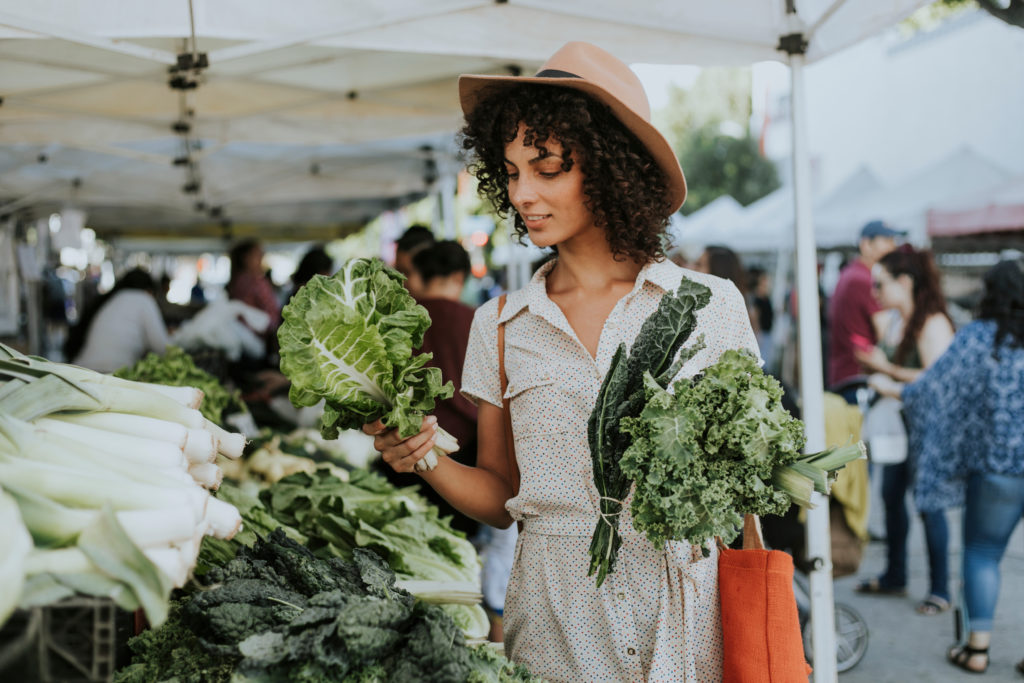
Becoming a vendor at a farmers market involves seven key steps:
- Creating a business plan
- Determining expenses and potential revenue
- Obtaining necessary licenses and permits
- Getting farmers market vendor insurance
- Deciding what to sell at the market
- Planning your booth setup
- Applying to markets
Farmers market shoppers are passionate about supporting local businesses and getting to know the people behind their food. Markets can be a profitable (and fun!) place to sell your food products, if you know how to do it right.
That’s what this guide is all about: the seven key steps to take when you want to start vending at farmers markets in a smart, safe, and sustainable way. Don’t forget to download our farmers market vendor business plan before you go!
1. Create Your Business Plan
If you haven’t already made one, you need a business plan long before you submit your first farmers market vendor application.
When you’re first starting out, it’s easy to think you can wing it and develop a serious plan later on after you’ve earned a spot at a market and started selling your products. However, many markets require you to submit a copy of your business plan along with your application. This includes famous ones, like Pennsylvania’s Lancaster Central Market, as well as smaller neighborhood markets.
A business plan isn’t just there to help you get into a market, though; it’s there for you. Running your business without a plan is like driving to a place you’ve never been without a GPS. Your business plan helps you navigate the twists and turns of entrepreneurship, making it easier to reach your goals and start turning a profit.
Every solid business plan includes the following sections (all of which are included in our downloadable template below).
Executive Summary
This is a brief, exciting description of your business. If you’re familiar with the term “elevator pitch,” it’s like that, but on paper. It’s meant to grab the attention of anyone reading your business plan, such as loan officers or market organizers, and give them a quick overview of your business.
Mission Statement
Your mission statement is your “why” — the reason you started your business, why you sell what you sell, and what goals you have for your business.
Do you have a passion for making locally grown produce more accessible to your community? Or, maybe you aim to educate people about the many benefits of local honey and encourage sustainable beekeeping. Perhaps you want to make someone’s day with a delicious homemade pastry. Whatever it is, put it in your mission statement.
Market Analysis
Market analysis involves three parts:
- Industry analysis: Understanding how your individual industry is growing and changing
- Competitor analysis: Identifying the competition and understanding how they are similar and different from you
- Customer analysis: Determining who your target customers are and what their buying behaviors are
Marketing Strategy
Your marketing strategy is your plan for promoting your business. This could include:
- Word-of-mouth/referrals
- Social media (Instagram, Facebook, TikTok, etc.)
- Your website
- Paid advertisements (e.g., Google Ads)
- Traditional advertising (e.g., flyers, newspaper ads, etc.)
It can (and should) change as you grow your business and learn the best ways to reach your target customers.
Loans & Financing
This is where you’ll detail how you finance your business operations, such as with personal funds, bank loans, or grants. Keep this updated so you have a clear picture of where your money is coming from at all times.
Operational Costs & Financial Projections
Detail your expenses here, including your:
- Fixed costs (expenses that don’t change throughout the year, such as your insurance premium)
- Variable costs (expenses that change throughout the year, like the cost of ingredients)
Also, include your profit margins and your projected annual revenue.
Certificate of Insurance (COI)
Your Certificate of Insurance (COI) is a document you can share with farmers market organizers (or anyone who asks to see it) that shows your business’ liability coverage and limits.
The market organizer might ask for their own copy of your COI, listing the market as an additional insured. This extends some of your policy’s liability protection to the market, so if an accident you’re responsible for leads to a claim against them, your policy can help respond.
Take some of the stress out of creating your business plan and grab a copy of our free template below!
2. Crunch the Numbers on Cost and Potential Revenue
It’s easy to think of farmers markets as a source of revenue for your business, but it also costs money to be a vendor. Let’s take a closer look at what expenses you should budget for.
Farmers Market Vendor Cost Breakdown | ||
Expense Type | What It Includes | Estimated Cost |
Application fee | Non-refundable fee to cover the cost of reviewing your application | $20–$50 |
Booth fee | Recurring fee for all vendors to rent a booth at a market | $20–$75 per week for most markets, $100+ for high-traffic urban markets |
Transportation costs | Gas, vehicle wear-and-tear, etc.; varies depending on your distance from the market | $10–$50 |
Packaging | To-go boxes, bags, product labels, etc. | $20–$50 |
Ingredients | Everything you need to make your products (varies widely depending on your business) | $50–$150 |
Gear | Tent, table, table cover, signage, coolers, etc. | $500–$1,500 |
Labor | The time it takes to pack, set up, work, tear down, and unpack after the market | $105–$250 per person each market day |
Food vendor insurance (required by most markets) | Monthly or annual liability insurance premium | $25.92 per month or $299 per year from Food Liability Insurance Program (FLIP) |
Estimating and budgeting for your expenses ahead of time helps set you up for a profitable market experience. Despite the costs, there is still good money to be made on market day.
Just like expenses vary, so do potential earnings. However, new vendors can typically expect to earn $200–$800 per market day. Once you’re a more established vendor, you can look forward to making closer to $1,000–$3,000 per day.
Did You Know? Your liability insurance premium can be affected by factors like:
- Your yearly business revenue
- The type of coverage you choose (e.g., you add tools and equipment insurance to your policy)
- If you’ve filed expensive claims in the past
Learn more about the cost of farmers market insurance and what you can do to keep your premium low.
3. Obtain Necessary Licenses, Permits, and Registrations
Doing a bunch of paperwork for your business isn’t the most exciting part of becoming a farmers market vendor, but it’s critical to help avoid fines and gain acceptance into different markets.
The types of licenses and permits you need can vary depending on where you live and what you’re selling, as well as what the market’s rules are. It’s always smart to check with the organizer of any market you want to participate in and get a list of required documents.
However, you can get a general idea of what you might need, what it does, how much it costs, and where to get it in the table below.
Type of License/Permit | What It Does | Typical Cost | Where to Get It |
Business registration | Registers your business with your state (may need to register with your city/county as well) | $0–$150 for a sole proprietorship; $50–$500 for a limited liability company (LLC) | Your Secretary of State or Department of Revenue (for local licenses, see your city or county clerk) |
Vendor’s license (aka a seller’s permit or sales tax permit) | Permits you to collect and remit sales tax | Typically free | Your state’s Department of Revenue or tax authority |
Food handler’s permit (aka a food worker card) | Issued after you or an employee completes a certification course covering food handling practices | ~$10 per person | Accredited programs such as Learn2Serve and ServSafe |
Food manager certification | Issued after you or an employee completes an advanced certification course covering food preparation | ~$65 per person | Accredited programs such as Learn2Serve and ServSafe |
Allows you to sell homemade food to the public legally | $25–$300 | Typically, your state’s Department of Agriculture |
Pro Tip: The U.S. Small Business Administration is a fantastic source of information on what you need to do to register your specific business, based on the way it’s set up (sole proprietorship, LLC, etc.).
4. Get Farmers Market Vendor Insurance
Along with permits and licenses, most farmers markets require you to have liability insurance. Yes, the market itself is insured, but that policy is there to protect them, not you. They want you to be financially prepared if you’re responsible for an accident on market day.
Most markets specifically require you to carry a general liability policy to cover any injuries or property damage you accidentally cause while vending. They normally look for a policy with the following coverage limits:
- $1,000,000 per occurrence limit (maximum amount your policy will pay for a single claim)
- $2,000,000 aggregate limit (maximum amount your policy will pay for all claims in a policy period)
Beyond being your golden ticket into markets, liability insurance can protect you from paying out of pocket in the event of a claim. Here’s a closer look at the types of insurance every farmers market vendor should have.
Type of Coverage | Coverage Trigger | What It Could Cover | Example Claim* |
|
| A gust of wind blows your booth’s canopy over, and it hits a shopper, injuring them | |
|
| A customer claims your brownies contained nuts that were not included on the label, causing them to have a severe allergic reaction | |
|
| You advertise that you’re the only 100% organic produce vendor at the market, but someone learns this isn’t true and sues you for false advertising | |
Tools and equipment (inland marine)** (strongly recommended) |
|
| A storm damages your card reader during setup, and it needs to be replaced |
(strongly recommended) |
|
| Someone steals your phone with your card reader app customer payment details are exposed |
*All policies have conditions, limitations, and exclusions. Please review your policy for exact details. Claim scenarios vary, and similar claims do not guarantee coverage.
**Available as an add-on coverage to a FLIP farmers market insurance policy; not included in a base policy
How to Get Affordable Farmers Market Vendor Insurance From FLIP
Food Liability Insurance Program (FLIP) is the trusted insurer of over 8,000 food vendors like you. We offer all of the above types of insurance (and more coverages) and provide farmers market insurance policies starting at just $25.92 per month, or $299 a year.
FLIP’s base policy automatically includes general liability, product liability, and personal and advertising injury coverage. Add tools and equipment (starting at $11.17/month) and cyber liability ($8.25/month) at checkout to easily customize your coverage. Plus, you can add additional insureds to your policy for free and download a copy of your COI at any time from your online account.
5. Decide What You’ll Offer
If you already sell food through other channels, such as online sales or wholesale retail, keep in mind that you may not want to bring all of your products to market. Having a thoughtfully curated selection helps you keep your booth organized and approachable. It also makes it easier to rotate certain products throughout the year to keep things fresh and exciting.
So, what factors should you consider when finalizing your selection?
Profitability
Some products are more profitable than others, so having them available at your booth is an excellent way to help ensure you come out in the black on market day.
Profitable food products tend to be ones that:
- Have wide margins
- Aren’t labor-intensive
- Use affordable, easy-to-source ingredients
- Are easy to produce in high volumes (e.g., batches of cookies)
- Have a high sell-through rate (typically products selling for <$10 that are easy to impulse buy)
Seasonality
Many people shop at farmers markets specifically because of how the selection changes from one season to the next, particularly with locally grown produce.
Even if you aren’t a produce vendor, there are still ways to embrace seasonality at your market stand:
- Create limited-time items or a menu that uses seasonal flavors and ingredients
- Include complementary recipe cards at your booth that show customers how to make different seasonal dishes using your products (especially great if you sell produce or dried spices)
- Sell sets/bundles during the holiday season for easy gifting
Demand
Always ensure you have a solid selection of reliably in-demand products in your rotation. It may take a little while to get a feel for what your best sellers are, but these products tend to be popular at any market:
- Locally grown produce
- Eggs
- Artisanal cheese
- Meat
- Bread
- Jams/preserves
- Baked goods
Competition
It’s always worth considering what other vendors will sell at each market you participate in, since competition can cut into profits.
If you can, visit the market(s) you’re interested in applying to before you go so you can scope out the competition and see what they’re selling. This isn’t to say you can’t sell the same product as someone else, although some markets won’t allow any direct competition. It just means you should also look for gaps in what’s available that you might be able to fill.
For example, if there’s another baked goods vendor at the market selling cookies like you do, is there a type of cookie they don’t sell that you could make?
6. Plan Your Booth Setup
Don’t wait for market day to decide how you want to arrange your booth. Practicing your setup before market day is the best way to know exactly what you need to bring and how you want it to look.
Pro Tip: Take pictures of your booth during your practice run so you can refer to them when setting up at the market.
Necessary Equipment & Supplies
The exact gear you need may vary depending on what you sell, but you should plan on having the following:
- Tables (usually 6–8 feet long)
- Canopy/tent
- Tablecloths/covers
- Display risers/baskets/crates
- Point of sale (POS) system and/or cash box
- Scale (if selling products by weight)
- Bags (produce, to-go, etc.)
- Disposable containers, utensils, and cups
- Generator (if needed)
- Coolers
- Signage
Layout & Display
Your booth layout can make or break your sales. An inviting, organized display encourages more people to stop by and makes people feel more confident buying from you.
Here are a few tips for creating the perfect booth setup:
- Use risers, baskets, and crates to display products at different heights
- Keep the checkout area open and accessible; display a sign showing customers where to line up to pay
- Clearly display prices next to each product to reduce confusion
- Create a sense of abundance with full displays
- Offer free samples (if your market and local health department allow them) to anyone who stops by; have a small garbage can nearby for people to throw away their toothpicks or paper cups
- Keep similar items displayed near each other (e.g., onion and garlic, jam and honey, etc.)
- Display photos around your booth to give a behind-the-scenes look at your business (e.g., pictures of your farm where your produce is grown, your home kitchen where you bake your cupcakes, etc.)
Pro Tip: Get more ideas for your farmers market booth from real FLIP customers.
7. Find a Farmers Market & Apply
Once you’ve done all the legwork, it’s time to apply to a market! Most markets now accept online applications, but be prepared to reach out to the organizers via email or phone if not.
You’ll typically need to submit the following with your application:
- Application fee
- Proof of insurance
- Copies of your license, permits, and tax information
- A brief description of the products you plan to sell
- Pictures of your products
- Your business plan
Of course, not every market is the same, and some might be a better fit for you than others. Here are some factors to consider when deciding which markets to apply to.
Attendance
High-traffic markets are highly desirable because of the number of potential customers, but it’s a good idea to visit the market yourself to get a feel for the quality of attendance.
Does the market look busy, but people are generally strolling through without stopping at booths? That’s a sign that foot traffic may not turn into sales. Keep in mind, crowds could make it harder for people to access your booth.
Reviews
Read Google reviews to get a sense of how shoppers feel about the market. Remember that reviews are often either glowing or extremely negative, so the truth probably lies somewhere in the middle.
Also, talk to current or former vendors at the market, if you can, to get a feel for what it’s like to participate.
Management
You may be able to speak to management at the market you visit, but chances are you won’t directly interact with them until you’re applying. However, you can get a feel for how the market is managed based on how well they promote it online and update their website.
Current Vendors
What kinds of vendors are already there? Sometimes markets list current vendors on their websites, but it’s never a bad idea to visit the market yourself and check it out. If there are too many vendors selling similar products to yours, it may be hard to get into the market, and if you do, competition will be fierce.
Proximity
There may be a popular market in a major city that you’d love to apply to, but if the commute involves a lot of traffic and it’s going to take you an hour both ways, it might not be worth it. Local markets reduce fuel costs for you, protecting your bottom line.
Common First-Time Farmers Market Vendor Mistakes (& How to Avoid Them)
While mistakes aren’t 100% avoidable, there are a few common first-time errors you can save yourself from repeating by being aware of them:
- Submitting your application late: Set a reminder on your phone at least a week before applications are due, and then another one the day before the deadline. Always aim to submit as early as possible so you don’t have to worry about missing out.
- Underpricing your goods: Follow a proven food pricing strategy to make sure you turn a profit. Never fall into the trap of simply pricing your products based on what the competition charges. Being aware of their prices is important so you know what people expect to pay, but aiming to match or undercut them at all times can quickly eat away at your margins.
- Showing up inconsistently: Shoppers appreciate consistency, so when you only show up to the market every so often, you risk losing trust. If you do have to miss a market day for some reason, announce it on your socials and your website so customers don’t expect to see you there.
- Scrambling to get proof of insurance: Rushing to get a short-term policy before every market day is expensive and makes it harder for you to provide a COI on demand. An annual policy from FLIP covers you for the year, and you can get a copy of your COI anytime online.
FAQs About How to Sell at a Farmers Market
How Much Does It Cost to Be a Vendor at a Farmers Market?
Most booth fees range from $20–$75 per week, but it’s important to factor in expenses beyond your booth, including:
- Transportation costs
- Labor
- Equipment
- Food vendor insurance
- Packaging
- Ingredients
When all is said and done, it can cost several hundred to one thousand dollars per week to take part in a farmers market.
What Is the Most Profitable Item to Sell at a Farmers Market?
Some of the most profitable items to sell at farmers markets include:
- Cookies/brownies
- Jams/preserves
- Spice blends
- Granola
- Bread
- Other baked goods
These items tend to have strong margins and are dependably popular with farmers market shoppers.
Is Selling at a Farmers Market Worth the Work?
Yes, while being a farmers market vendor is work, it’s a stellar way to sell your food products and grow your customer base. As long as you track your expenses, price your items accordingly, and choose a popular market, you can earn good money as a vendor.
Get six tips for farmers market vendors from the standholders at historic Lancaster Central Market in Pennsylvania.
Does My Business Need to Be an LLC to Sell at a Farmers Market?
No, your business does not have to be a limited liability company (LLC) to become a farmers market vendor. Many vendors are sole proprietors, but some do choose the LLC route because it provides protection if someone sues your business. They won’t be able to go after your personal assets like they could if you were a sole proprietor — only your business assets.

Alex Hastings
Alex Hastings is a licensed insurance agent in the state of Washington. Alex leverages her experience as a lover of fast-casual food, baked goods, and iced oat milk lattes. She holds a B.A. in Creative Writing from Western Washington University. Before working at Veracity, she was a retail copywriter at Zulily and an English language teacher in South Korea. Alex is fully trained on FLIP insurance coverages and writes content that connects food and beverage business owners with the policies they need.
Alex Hastings is a licensed insurance agent in the state of Washington. Alex leverages her experience as a lover of fast-casual food, baked goods, and iced oat milk lattes. She holds a B.A. in Creative Writing from Western Washington University. Before working at Veracity, she was a retail copywriter at Zulily and an English language teacher in South Korea. Alex is fully trained on FLIP insurance coverages and writes content that connects food and beverage business owners with the policies they need.

Andrew Adamus
Andrew Adamus is a Program Manager for Food Liability Insurance Program (FLIP). He is an underwriting leader with more than a decade of experience in commercial insurance, holding an MBA from Syracuse University along with AINS, API, AU, and AIS designations. Andrew believes that successful underwriting is built on strong relationships, thoughtful analysis, and a commitment to helping policyholders protect what matters most. His goal is to deliver insurance solutions that support long-term success.
Andrew Adamus is a Program Manager for Food Liability Insurance Program (FLIP). He is an underwriting leader with more than a decade of experience in commercial insurance, holding an MBA from Syracuse University along with AINS, API, AU, and AIS designations. Andrew believes that successful underwriting is built on strong relationships, thoughtful analysis, and a commitment to helping policyholders protect what matters most. His goal is to deliver insurance solutions that support long-term success.