Crafting your menu and building your brand may be more exciting, but obtaining all your necessary licenses and permits is just as important. Operating without required documents could lead to expensive fines or temporary closures.
Our guide makes it easy to learn what permits you need for your food truck, how much they typically cost, and where you can get them. Plus, get helpful tips on how to navigate the licensing process, and learn why getting food truck insurance is a crucial step you don’t want to skip.
TL;DR: While exact requirements vary by state, county, and/or city, there are 13 licenses and permits most food trucks need to operate legally.
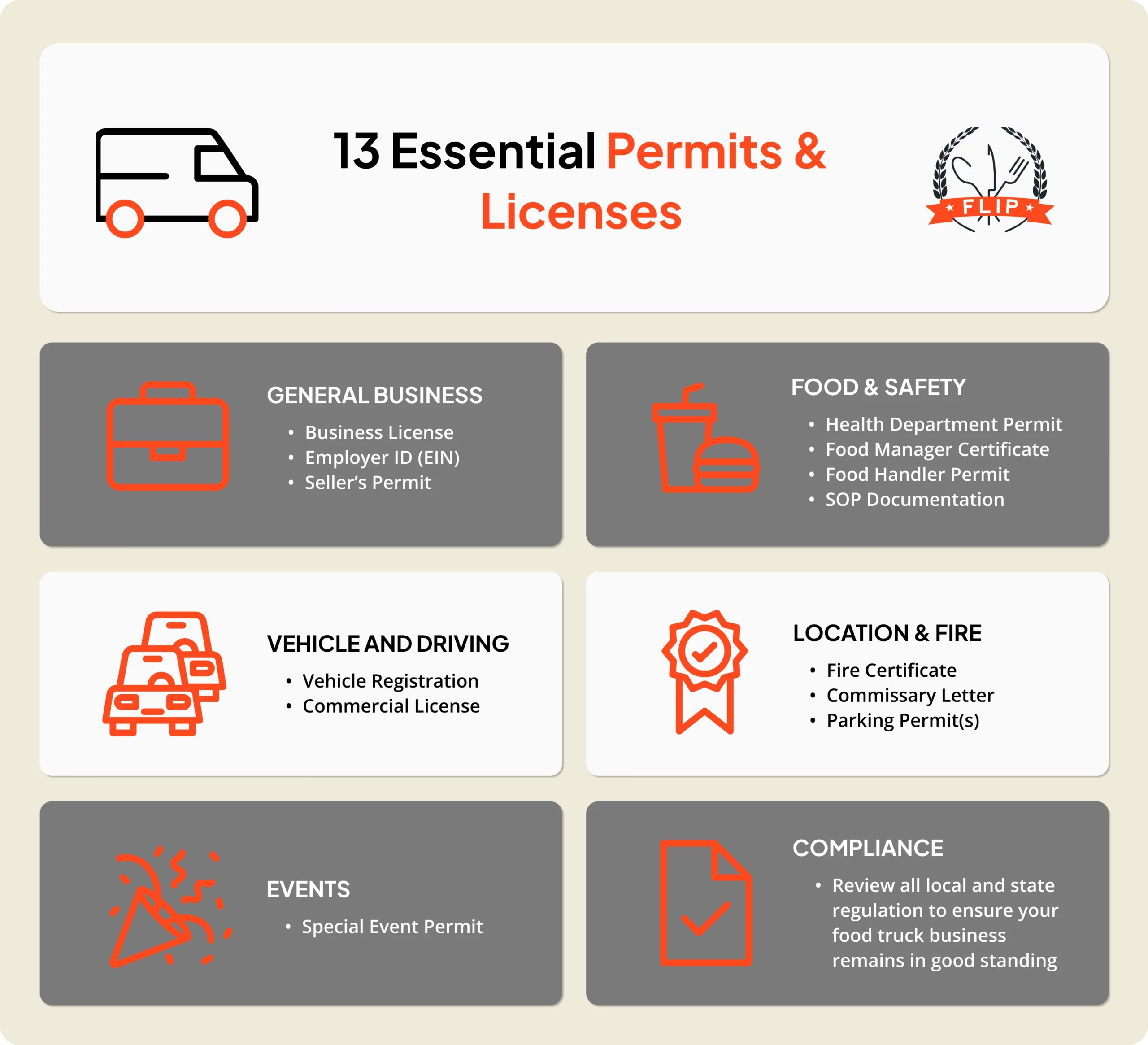
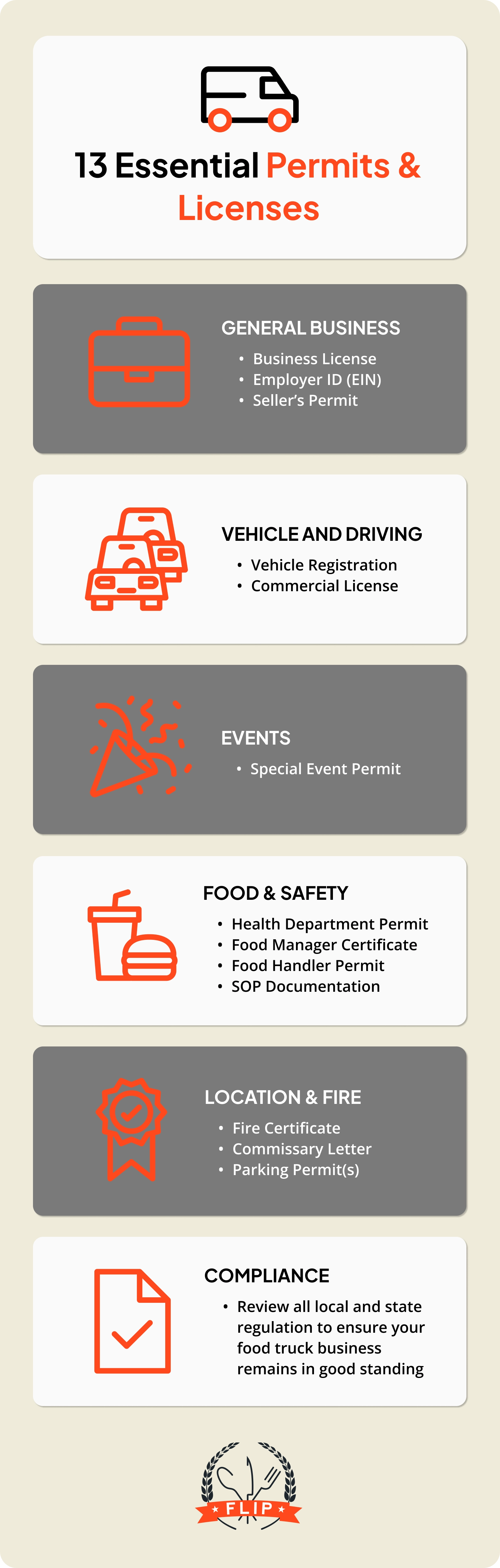
13 Common Permits and Licenses for a Food Truck
Unfortunately, there are no universal requirements for a food truck when it comes to licenses and permits. The exact documentation you need is usually decided at the state, county, or even city level.
However, there are 13 licenses that most entrepreneurs need to start their food truck business and sell food legally.
1. Business License
What it is: A business license allows you to operate your food truck in your city or state. You may also see it referred to as a basic business operation license or a mobile food vendor license, depending on where you live. It proves that your local government recognizes your food truck as a legitimate business.
Typical cost: $50–$500
Where to apply: Your city/county government website
Did You Know?
Many cities require proof of mobile food business insurance before they issue a business or vendor license. This usually includes general liability limits of $2,000,000 aggregate (max. paid per policy period) and $1,000,000 per occurrence (max. paid for any one claim).
Learn more about the cost of food truck insurance and why it’s a critical investment in your business’ success.
2. Employer Identification Number (EIN)
What it is: Otherwise known as your federal tax number, this ID is issued by the Internal Revenue Service (IRS). It’s used for tax purposes, and you need it to open a bank account, create a credit profile for your business, and hire employees.
Typical cost: Free
Where to apply: IRS.gov
3. Health Department Permit
What it is: You may see this referred to as a public health permit or a food service license. It’s issued by your local health department once your food truck passes a health inspection. An inspection determines if your food truck violates any health codes, which are typically set by your city or county.
This includes evaluating cleanliness and food storage practices. Inspections generally end with a list of instructions for how to improve your operations, as well as a grade that you may be legally required to display where customers can see it.
Typical cost: $50–$1,000
Where to apply: Your city or county health department website
Pro Tip: Prepare for your first inspection with our handy health inspection checklist, featuring essential tips to help you pass with flying colors.
4. Standard Operating Procedures (SOP) Document
What it is: Some cities or counties require food trucks to submit additional documentation that explains the day-to-day operations of your food truck. That includes what you serve and how you prepare it, your cleaning/sanitation routine, and how you keep your truck secure when not in use. Some areas may refer to this as a plan review.
Typical cost: Free (often submitted alongside your health permit application)
Where to apply: Your city or county health department website
5. Food Manager Certificate
What it is: You can earn this certificate by passing a food manager course that prepares you to manage food safety and preparation in your food truck. Many health departments require all food businesses (including food trucks) to have one certified food manager on staff at all times during operating hours. Please note that this is different from a food handler’s permit, which we cover below.
Typical cost: $100–$200 per person
Where to apply: Programs approved by your local health department (often ServSafe Manager and Learn2Serve Food Safety Manager)
6. Food Handler’s Permit
What it is: Food handler’s permits are required for anyone preparing, cooking, or handling food in many states. Like a food safety manager, anyone applying for a food handler’s permit must pass a course on food safety and the prevention of foodborne illness, but this is typically less comprehensive than the manager’s course.
If you have employees, it’s a good idea to require them all to carry this permit, even if it isn’t legally mandated.
Typical cost: $10–$50 per person
Where to apply: Programs approved by your local health department (often ServSafe Food Handler or Learn2Serve Food Handlers Card)

7. Commercial Driver’s License
What it is: A commercial driver’s license legally permits you to drive a business vehicle (in this case, your food truck).
Just like you need a driver’s license to drive your own personal vehicle, there’s a good chance you need a commercial driver’s license to operate your food truck. In some places, a regular driver’s license meets the requirements, but depending on the size and weight of your food truck, it may not be enough.
Typical cost: $10–$100
Where to apply: The Department of Motor Vehicles (DMV) in your state
8. Vehicle Registration
What it is: You will likely be required to obtain a commercial vehicle registration for your food truck. This document proves that you own and operate your food truck, and that your truck meets your local emissions standards (if you have them).
Typical cost: $50–$500
Where to apply: The DMV in your state
9. Seller’s Permit
What it is: A seller’s permit typically allows you to collect and remit sales tax on your food and beverage products. It may also allow you to purchase ingredients wholesale without paying sales tax to avoid being taxed twice.
Typical cost: Free, but may include a small processing fee
Where to apply: Your state tax authority
10. Fire Certificate
What it is: Similar to your health department permit, a fire certificate is issued by your local fire department to confirm that your food truck follows safety code. You may only need a fire certificate if you have cooking equipment installed in your food truck. If your gear doesn’t pose a fire hazard, you might be able to skip this inspection.
Typical cost: $25–$500
Where to apply: Your local fire department or fire marshal’s office
11. Commissary Letter of Agreement
What it is: It’s common for local governments to require all food trucks to rent a commissary or commercial kitchen space for public safety reasons. In some cases, you may be required to do all or most of your food preparation, dishwashing, or even cooking at a commissary rather than in your truck. In most cases, you are expected to store all of your food and ingredients at the commissary during off hours, instead of inside your truck.
Your commissary letter of agreement confirms you have access to this type of space, and usually includes what kind of facilities and amenities are available to you. This includes waste disposal services, running water, or commercial-grade cooking equipment.
Typical cost: Varies widely, but rent can range from $250/month for smaller shared-use kitchens to $3,000/month for bigger spaces in urban areas
Where to apply: Submit letter of agreement to your local health department (if required)
12. Parking Permit(s)
What it is: Zoning laws often require food truck owners to obtain special parking permits to sell in certain areas. These laws are generally determined by the city, so if you plan to park and sell in multiple jurisdictions, you need to obtain parking permits for each of them.
Parking permits usually come with restrictions, such as the hours you can park your food truck at a specific location and whether you’re allowed to park there overnight.
Typical cost: $50–$1,000
Where to apply: Your city clerk or parking/zoning authority’s website
13. Special Event Permits
What it is: If you plan on participating in any events with your food truck, there’s a good chance you’ll need a special event permit for each of them. This permit allows you to sell food at a venue for a specific amount of time (usually the length of the event). You may also hear it referred to as a vending permit.
Always check with the event coordinator or venue manager to determine what type of special event permit you need, and how long you need it for.
Typical cost: $25–$300
Where to apply: Your city/county’s special events division

Tips for Navigating the Food Truck Licensing Process
Knowing which licenses you need is the first step. The next? Actually applying for them. Here are a handful of helpful tips to make this process smoother and avoid common mistakes that could lead to delays.
Start With Your Health Department
In most cases, your local health department determines which licenses and permits you need, even if some of them have to be obtained through other government agencies.
- Check your city or county health department’s website
- See if they have any specific guides, packets, or checklists catered to starting a food truck or mobile food business
- Confirm what food truck equipment you’ll need and if you need to rent a commissary or commercial kitchen space
Gather All Required Documents
The exact documentation you need to provide varies depending on which permits you need and where you live, but you can generally expect to provide your:
- Business registration
- EIN
- Commissary agreement letter
- Truck layout and/or equipment plan
- Certificate of Insurance (COI)
Getting all your documentation in order before you start applying can speed up the process and ensure you don’t forget anything.
Apply for Your Permits in the Right Order
While this order may vary depending on which permits you need and what your local health department recommends, most food truck operators follow a similar application order.
- Register your food truck and get your EIN
- Register your truck and protect it with food truck commercial auto insurance
- Rent a commissary or commercial kitchen and get your agreement letter
- Submit a plan review to your health department (if applicable)
- Obtain food safety certifications for you and your employees
- Schedule health and fire inspections
- Apply for parking permits and/or special event permits
Keep in mind, you can only receive some permits following a successful inspection, including your health and fire permits.
Be Prepared to Make Adjustments
Once your food truck has been inspected by your local health and fire departments, there’s a fair chance you will be asked to make updates to your setup and equipment. For example, they may require you to install specific fire safety equipment to meet their standards, or change the way you store food to prevent cross-contamination.
This is a normal part of the process. Just remember to be flexible, ask questions when needed, and be ready to make those adjustments quickly so you can hit the road faster.
Keep Track of Renewal Dates
Many food truck permits need to be renewed regularly. However, once you open for business, your day-to-day is about to get a lot more hectic, and it’s easy to forget or postpone renewing permits until it’s too late.
How often you need to renew each permit varies depending on your location, but in many cases, you need to renew your health permit yearly. Some others, like food safety certifications, may be valid for a few years. Note the expiration dates on all your permits and licenses, and set a reminder on your calendar when it’s time to renew.
Protect Your Food Truck With FLIP
Food truck licenses and permits are an important part of starting your business, but they’re far from the only step. Insurance is just as critical, even if it feels like another expense to add to your list.
In reality, insurance is an essential investment in your food truck’s future. If a customer gets sick from something you served them, or your food truck gets rear-ended on the way to an event, insurance can cover some (or all) of the costs.
FLIP offers general liability insurance for food trucks, designed to cover injuries to other people or damage to other people’s property caused by your business activities. We also offer commercial auto insurance for food trucks, and other helpful add-ons like:
Don’t let one mistake block your road to success. Get food truck insurance starting at $25.92 a month and enjoy the peace of mind that comes with knowing you’re covered.
FAQs About Licensing and Permitting Requirements for a Food Truck
Can I Run a Food Truck Without Licenses and Permits?
Not without facing fines, suspensions, or the permanent closure of your food truck. Permits and licenses may feel like another hurdle when starting your business, but they exist for good reason. They ensure your business adheres to health and safety standards and doesn’t pose a disruption to other businesses or citizens.
How Long Does It Take to Get Food Truck Permits and Licenses?
For some food trucks, it may only take a few months to apply and receive the permits they need to start serving customers. However, it may take significantly longer if you live in an area that limits the number of permits issued per year. For example, New York City only issues 445 mobile food vending permits each year, and it can take years to move off the waitlist.
Do Food Trucks Need a Commissary Kitchen?
In many cases, yes. It’s common for cities and counties to require mobile food businesses to use a designated commercial kitchen or commissary space for some operations, including food storage and cleaning equipment.
Check with your local health department to see if they have a commissary requirement.
Is Insurance Legally Required for a Food Truck?
Some cities and counties may require a COI that proves you have general liability coverage before issuing certain permits. Your state may also require commercial auto insurance for your food truck.
Can a Food Truck Operate in Multiple Cities?
Yes, but be prepared to obtain separate licenses for each city you operate in. Some areas, like Colorado, have streamlined certain permits to make it easier for food trucks to operate across the state without needing separate permits for each municipal area.
Learn more about which cities are best for food trucks.

Alex Hastings
Seattle-based copywriter and (WA) licensed insurance agent Alex Hastings leverages her experience as a lover of fast-casual food, baked goods, and iced oat milk lattes. She holds a B.A. in Creative Writing from Western Washington University. Before working at Veracity, she was a retail copywriter at Zulily and an English language teacher in South Korea. Alex is fully trained on FLIP insurance coverages and writes content that connects food and beverage business owners with the policies they need.
Seattle-based copywriter and (WA) licensed insurance agent Alex Hastings leverages her experience as a lover of fast-casual food, baked goods, and iced oat milk lattes. She holds a B.A. in Creative Writing from Western Washington University. Before working at Veracity, she was a retail copywriter at Zulily and an English language teacher in South Korea. Alex is fully trained on FLIP insurance coverages and writes content that connects food and beverage business owners with the policies they need.

Kyle Jude
Kyle Jude is the Program Manager for FLIP, where he helps develop and maintain liability coverage designed for mobile food vendors across the country. With 10+ years of experience in the insurance industry, he works closely with carriers, underwriters, and compliance teams to ensure coverage stays accurate, compliant, and responsive to the real-world risks of food businesses.
Kyle Jude is the Program Manager for FLIP, where he helps develop and maintain liability coverage designed for mobile food vendors across the country. With 10+ years of experience in the insurance industry, he works closely with carriers, underwriters, and compliance teams to ensure coverage stays accurate, compliant, and responsive to the real-world risks of food businesses.