
Food product liability insurance is designed to cover third-party injury and property damage claims caused by your food or beverage product after it’s been sold.
Your food or beverage business needs a variety of coverages to shield it against risk, and product liability insurance is one of those essentials.
Learn everything you need to know about this coverage, from what it covers to how you can get it in minutes from Food Liability Insurance Program (FLIP). Plus, download our free risk mitigation checklist to reduce your chances of a product-related incident.
What Is Food Product Liability Insurance?
Product liability insurance for food businesses is designed to cover the cost of injuries to others or damage to their property stemming from your product.
Your products include anything you manufacture, sell, handle, or distribute. For businesses like caterers or restaurants, the food you prepare counts as your product.
This coverage is built to protect you if a customer gets sick or injured after buying and/or eating your product. Common incidents include:
- Food poisoning
- Cross-contamination
- Foreign objects in food
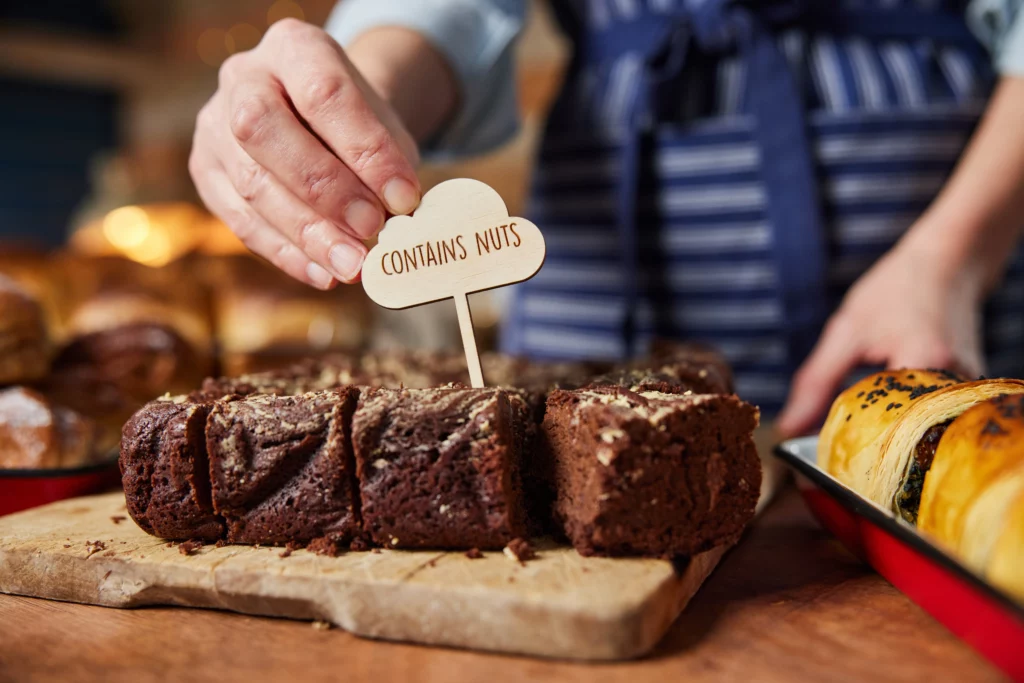
- Unlabeled allergens
- Dangerous packaging defects
If your customers experience any of the above after purchasing a product from you, they might sue to cover their damages. That includes medical bills and lost wages if they had to miss work while they were hospitalized or recovering.
Unfortunately, these incidents are quite common. According to the Food and Drug Administration (FDA), 1 in 6 Americans will contract a foodborne illness each year, leading to roughly 128,000 hospitalizations and 3,000 deaths.
This is where product liability coverage comes in. Normally, you’d be on the hook for those expenses, as well as your own defense costs like court fees and hiring an attorney. With food product liability insurance, you could have some or even all of those costs covered for you.
Product Liability vs. Product Recall: Key Differences
Product liability coverage is often confused with product recall insurance. For starters, their similar names are easy to mix up, but they also both cover claims stemming from your products.
Despite these similarities, the two policies are distinctly different, and it’s essential to understand the differences between them.
Product recall insurance specifically covers costs you face if you need to recall a product, either by choice or by force from the FDA. That typically includes money you spend to:
- Notify customers
- Collect the product
- Destroy the product
- Repair your reputation via a public relations (PR) or crisis management firm
These recall-related expenses are excluded under a product liability policy.
Swipe →
| Product Liability | Product Recall | |
|---|---|---|
|
Purpose |
Covers costs you are legally responsible for if your food/beverage product makes someone sick or injures them |
Pays for expenses you face while recalling your food or beverage product |
|
Coverage Trigger |
A lawsuit or claim from a customer who became sick or injured because of your product |
A safety concern, such as possible contamination or packaging defect, leads you to recall potentially affected products (either by choice or by force) |
|
What It Covers |
|
|
|
Key Exclusions |
|
|
|
Example Claim |
A customer has a bad reaction to an unlabeled allergen in your product and sues you |
You learn that your products have an unlabeled allergen in them after a customer has a reaction and need to recall all affected products |
|
Included in a General Liability Policy? |
✅ Yes (with FLIP) |
❌ No |
Businesses That Need Food Product Liability Insurance
The short answer is that every business that manufactures, sells, or distributes a food or beverage product needs product liability insurance.
This includes, but isn’t limited to:
- Bartenders (and other alcohol-serving businesses)
- Chefs
- Caterers
- Food and beverage vendors
- Food distributors
- Food manufacturers
- Home-based food and beverage businesses (aka cottage food)
- E.g., home-based bakers or caterers
- Mobile food and beverage businesses (e.g., food trucks and trailers)
- Restaurants
No matter how careful you are, there is always a chance a customer could become sick or injured because of your product. If they sue, you’ll be glad to have product liability insurance in your court, so you aren’t left alone to cover those expenses.
What’s Covered and What Isn’t
Like any policy, product liability insurance covers specific claims and excludes others. It’s one of several coverage types your business needs to stay protected against claims.
Toggle the dropdowns below to view common product liability coverages and exclusions. Please note that you should always refer to your policy for a full list of exclusions — these are simply for reference.
Coverages
- Third-party bodily injury claims caused by your product
- Third-party property damage claims caused by your product
- Legal expenses if sued over injury, illness, or damage caused by your product
Exclusions
- Bodily injury to others not directly caused by your food/beverage product (typically covered by general liability insurance)
- Damage to others’ property not directly caused by your food/beverage product (typically covered by general liability insurance)
- Recall expenses (e.g., investigating, collecting, and destroying products)
- Fines from government agencies for incorrect labeling or improper sanitation that lead to a recall
- Products considered supplements by the FDA (e.g., anything intended to treat, cure, or prevent a disease)
Limits and Cost: Typical Options and Determining Factors
Most food product liability insurance policies have the following coverage limits:
- $2,000,000 aggregate (the max your insurance will cover in a policy year)
- $1,000,000 per occurrence (the max your insurance will cover for any one particular claim)
These limits are often listed on your policy as “products-completed operations coverage.” $1,000,000 per occurrence/$2,000,000 aggregate is the standard for small to mid-sized food and beverage businesses.
Product liability coverage is included in a base FLIP policy alongside general liability coverage, which starts at just $25.92 a month. That means it’s available at no additional cost to you.
While this is the starting price, your premium may increase based on factors like:
- Your business’ gross annual revenue
- If you’ve ever filed a claim before
- What state(s) you do business in
- Which optional coverages you add to your policy
How to Get Food Product Liability Insurance in <10 Minutes
Getting product liability insurance for your food business from FLIP is easy, especially since we include it in our base food liability policy! Follow these steps to get the coverage you need:
- Start your application
- Select your business type(s) and fill out required information (e.g., name, location, and contact info)
- Add any optional coverages to your policy (e.g., tools and equipment or cyber liability)
- Get your free quote and finish checking out
Most people can get their policy in 10 minutes or less, so you can buy coverage on your lunch break or between orders.
Risk Prevention Tips for Avoiding Food Product Claims
Taking proper precautions helps you keep the cost of your coverage low. Businesses with a history of filing claims pose a greater risk to insurance companies, and their premiums may increase as a result.
While you can’t prevent 100% of accidents (hint: that’s why insurance is so critical!), the following risk mitigation strategies decrease the odds of one happening to you.
Audit Your Labels
Labels aren’t exclusive to packaging. For restaurants and other similar businesses, their menu often acts as their food label, specifying which items include common allergens or dietary restrictions.
It’s critical to double or even triple-check your labels to ensure they include all the necessary ingredient and allergen disclosures. Let’s say a customer with a nut allergy purchases a muffin from a baker, thinking it’s nut-free because it wasn’t labeled otherwise. If they have a reaction to that muffin, they have grounds to sue the baker for negligence.
Always follow the food labeling guidelines set by the FDA to avoid causing unnecessary harm to customers and getting hit with regulatory fines.
Keep Equipment Clean and Serviced
Whether you’re manufacturing or preparing food, keeping your equipment clean and functional is key to preventing customer illnesses and injuries.
For instance, if a manufacturer’s equipment hasn’t been inspected as often as it should, a piece could break off and fall into a batch of food. Similarly, dirty equipment can lead to a bacterial breeding ground that contaminates your products.
Always follow your equipment manufacturer’s recommendations for servicing and clean your equipment daily to prevent the spread of germs.
Follow Food Safety Procedures
If you aren’t taking steps to avoid cross-contamination, an illness can easily spread from one surface to another and make a customer sick. This includes designating separate cutting boards for meat, fish, and vegetables.
Cross-contamination also includes allergens, which are sometimes easy to overlook. If you prepared a PB&J for one customer on a cutting board, you can’t use that same board to prepare a ham sandwich. If the person eating the ham sandwich has a peanut allergy, this simple mistake could land them in the hospital.
You and your employees should take a food safety course, such as Learn2Serve or other state-approved courses, to learn prep and handling best practices.
FAQs About Product Liability Insurance for Food Businesses
Does Product Liability Insurance Cover My Food Products?
In most cases, it’s not difficult to obtain this coverage for your business. However, there are a few factors that might make an insurance underwriter reluctant to give you a quote, such as:
- Your product’s country of origin: If your food comes from a country with fewer regulations on things like growth hormones or perishable food storage than the US, it may pose a higher risk for liability claims.
- How you prepare your product: In some states, you may have to meet commercial kitchen requirements by renting a commissary for all of your food prep and storage. Insurance underwriters want to make sure your business follows state law, especially if you run a home-based operation.
- Any health claims you make: If you include any health claims on your product label, such as your product containing essential vitamins and minerals, your underwriter will want proof that the FDA has approved this claim.
- If your product is considered a supplement: The FDA defines a supplement as a product intended to treat, diagnose, cure, or prevent a disease. Supplements are traditionally excluded under typical product liability policies. Some insurance companies specialize in covering these products, though.
How Do I Get Proof of Insurance and Add Additional Insureds?
With FLIP, access your Certificate of Insurance (COI) immediately after purchasing your policy by logging in to your user dashboard.
While there, you can also add any additional insureds to your policy and download copies of your COI with them listed. You’ll also have the option to add additional insureds during checkout.
Do I Need Liability Insurance to Sell Food?
Yes, liability insurance is a critical part of running a food or beverage business. It provides a financial safety net that can save you from paying out of pocket if the worst happens, like a customer getting sick from your food.
Even if you aren’t legally required to have it to open your business, liability insurance is not something you want to skip out on. It might feel like just another expense, but think of it more like an investment in your business’ future.
One expensive claim could lead to the shutdown of your business. With liability insurance, you can keep feeding hungry customers while your insurance policy has your back.

Alex Hastings
Seattle-based copywriter and (WA) licensed insurance agent Alex Hastings leverages her experience as a lover of fast-casual food, baked goods, and iced oat milk lattes. She holds a B.A. in Creative Writing from Western Washington University. Before working at Veracity, she was a retail copywriter at Zulily and an English language teacher in South Korea. Alex is fully trained on FLIP insurance coverages and writes content that connects food and beverage business owners with the policies they need.
Seattle-based copywriter and (WA) licensed insurance agent Alex Hastings leverages her experience as a lover of fast-casual food, baked goods, and iced oat milk lattes. She holds a B.A. in Creative Writing from Western Washington University. Before working at Veracity, she was a retail copywriter at Zulily and an English language teacher in South Korea. Alex is fully trained on FLIP insurance coverages and writes content that connects food and beverage business owners with the policies they need.

Kyle Jude
Kyle Jude is the Program Manager for FLIP, where he helps develop and maintain liability coverage designed for mobile food vendors across the country. With 10+ years of experience in the insurance industry, he works closely with carriers, underwriters, and compliance teams to ensure coverage stays accurate, compliant, and responsive to the real-world risks of food businesses.
Kyle Jude is the Program Manager for FLIP, where he helps develop and maintain liability coverage designed for mobile food vendors across the country. With 10+ years of experience in the insurance industry, he works closely with carriers, underwriters, and compliance teams to ensure coverage stays accurate, compliant, and responsive to the real-world risks of food businesses.